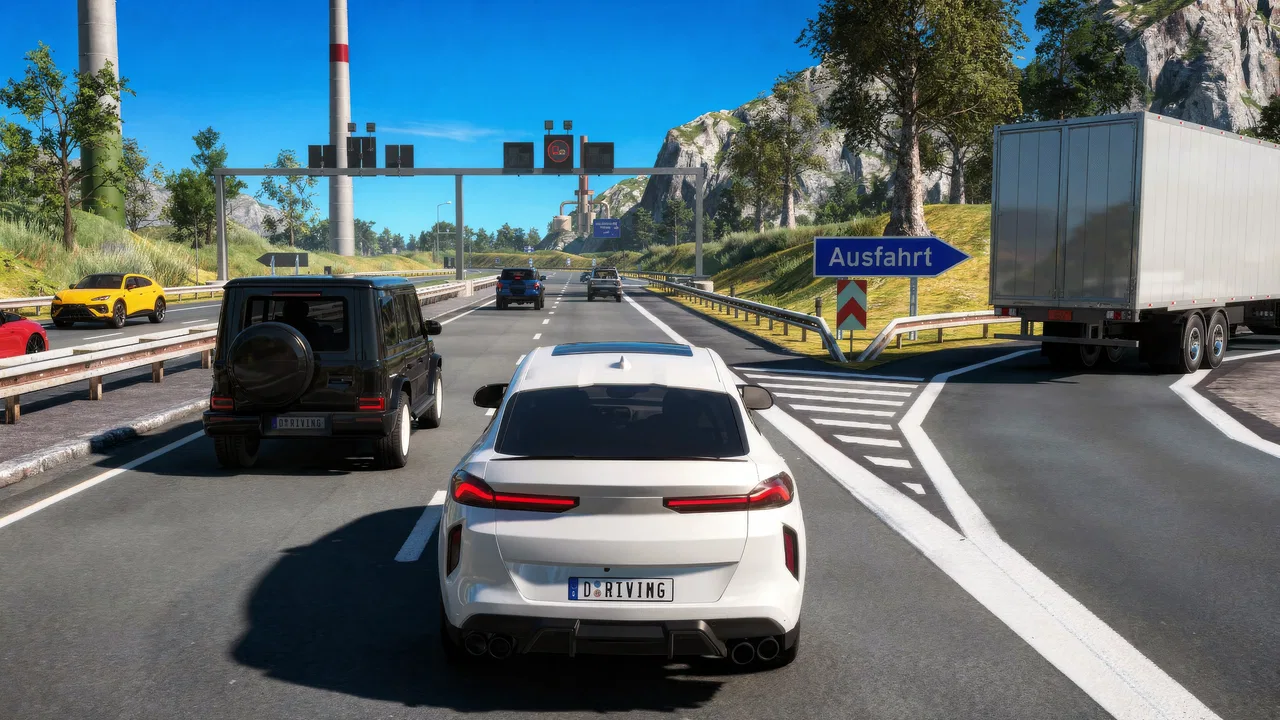
Driving School Simulator : EVO
- 4.6
- Rating
- 5.00M
- Installs
- Free
- Price

 Analysis by App-foxy
Driving School Simulator: EVO is the kind of racing game I opened expecting a few relaxed parking challenges and ended up treating more like a driving practice playground. Developed by Ovidiu Pop, it focuses on ordinary road situations rather than pure speed: positioning a car, judging corners, handling city traffic, and learning how much space a larger vehicle needs. That slower approach is its main identity, and it also explains why the game will appeal to some players far more than a typical arcade racer.
After spending time with it, I see the game as a useful choice for people who enjoy careful driving games, parking challenges, and vehicle variety. It is free to start, rated Everyone, and has attracted more than a million installs with a 4.6 average from roughly fifty thousand ratings. Those numbers suggest a healthy audience, but they do not remove the important question: does it remain interesting once the first novelty disappears? My answer is qualified. It can earn a regular place on your phone, but only if you enjoy repetition with small improvements rather than constant excitement.
From the first week to a lasting driving habit
I find the first week most useful as a low-pressure way to learn how each vehicle responds, rather than as a race to unlock or finish everything. Once that initial curiosity settles, setting a small personal goal—like taking a turn more cleanly—can keep a short session satisfying without making play feel like a chore. That shift in motivation leads naturally to the question of what progress feels like over time.
You May Also Like

 Blood Strike: 2.5 Anniversary
Blood Strike’s Loadouts Turn Every Drop Into a Tactical Gamble
A close look at Blood Strike’s custom loadouts: how fast access to signature weapons reshapes its battle royale rhythm, rewards preparation, and narrows the gap between fights.

 Pandora - Music & Podcasts
Pandora’s Music Is Easy to Start, but Harder to Recover
Pandora’s strength is its low-effort path from a seed to a station. Its weak spot is how much confidence it asks you to place in connection, setup, and quiet recovery.

 8 Ball Pool
 Is Built on Rivalries, Rematches, and Routine
A close look at the rivalries, rematches, shared routines, and unanswered safety questions that turn a quick pool match into a persistent mobile community.

 Samsung Music
’s Quiet Strength Is Playing What You Already Own
Its reach comes less from spectacle than from dependable access to a personal library. That simplicity is both the app’s strongest retention engine and its ceiling.

 AccuWeather: Weather Radar
AccuWeather Review: A Quick, Clear Forecast for Everyday Decisions
For everyday plans, the best forecast is the one you can understand quickly. AccuWeather makes rain timing, radar, and local conditions easy to act on, with a few trade-offs.

 Hill Climb Racing
Why Hill Climb Racing Still Turns Crashes Into One More Run
A tiny car, a bumpy hill and one more upgrade: Hill Climb Racing keeps resurfacing because its simple chaos makes every near-miss feel personal.
More From Our News Desk



Why the opening sessions work
The first week is where the game makes its strongest impression. The basic appeal is immediately understandable: choose a vehicle, enter a city-driving situation, and try to complete the task without treating every street like a racetrack. The store summary describes cars, buses, trucks, and vans, and that range matters in practice because each type changes how I approach the same general problem. A compact car feels forgiving; a bus or truck makes turning space and braking feel much more important.
I particularly like that the game gives parking and urban driving their own weight. In many racing games, slowing down feels like wasting time. Here, slowing down is often the sensible move. I found myself checking my angle before committing to a turn, leaving more room around obstacles, and correcting a bad approach instead of forcing it. That creates a satisfying connection between the controls and the result, even when the task itself is simple.
The first useful tip is to resist the temptation to rush through early challenges just because the vehicle feels easy to control. I get more value by using the opening sessions to learn the camera and steering response. A camera angle that looks comfortable while moving forward may be awkward when reversing into a space. Switching viewpoints before a tight maneuver, rather than after hitting something, makes the parking sections much less frustrating.
That small habit also reveals one of the game’s better qualities: it rewards preparation more than reflexes. I do not need the fastest reactions to make progress. I need to notice where the vehicle is pointed, understand how wide it is, and avoid turning too early. For younger players or anyone who finds competitive racing stressful, this makes the game approachable. The Everyone rating fits that accessible presentation, although patient supervision can still be useful when a child is using optional purchases.
What makes the vehicle selection meaningful
Vehicle variety is not just a visual change. Moving from a car to a van changes how close I can safely pass a corner. A truck makes reversing and alignment more demanding, while a bus encourages me to think about the rear of the vehicle rather than only the front. This is one of the more concrete reasons to keep playing after the initial introduction: the same city-driving mindset becomes more complicated when the vehicle’s proportions change.
I recommend starting with the vehicle that feels easiest to place accurately, then returning to larger vehicles once the controls feel familiar. That workflow is more productive than immediately choosing the biggest option for novelty. It lets me separate two kinds of difficulty: learning the control system and managing a long vehicle. When both are unfamiliar at once, a mistake can feel random even when it is really a positioning problem.
The game is also a good fit for short sessions. If I have a few spare minutes, I can attempt a driving or parking task without needing to commit to a long race. That makes it different from a conventional racing game built around full events, overtaking, and speed. It is closer to a repeated practice routine. The trade-off is obvious: players who need dramatic competition may find the slower pace dull once the first few sessions are over.
Where the usual racing alternatives are better
Compared with an arcade racer, this game offers less instant spectacle. There is no reason to expect every session to deliver the rush of high-speed competition, because its appeal comes from control and accuracy. If I want quick victories, aggressive overtakes, or a constant sense of acceleration, a dedicated arcade racer is the better choice. Driving School Simulator: EVO asks me to appreciate a clean maneuver, not just a finish line.
Compared with a highly realistic simulator, however, it is easier to pick up. I do not need specialist equipment or a long setup routine to begin. The phone format makes it convenient for casual practice, while the range of vehicles gives it more depth than a basic parking toy. Its middle position is useful: more deliberate than an arcade game, but less demanding than a full simulation setup.
That middle ground is also its biggest limitation. Simulation fans may eventually want more detailed systems and greater environmental complexity, while arcade fans may feel that the game spends too much time asking them to be careful. I would not recommend it as a universal racing game. I would recommend it specifically to someone who enjoys the process of lining up a vehicle correctly and improving through repeated attempts.
How the first month changes the experience
After the first month, the question becomes whether the driving tasks still feel meaningful. For me, the answer depends on how I play. If I treat every challenge as something to clear as quickly as possible, the routine becomes repetitive. If I use different vehicle types and focus on cleaner approaches, the game retains more value. The difference is not a hidden trick; it is a choice about whether I want completion or practice.
One practical use case is a short evening session after work or school. I can play a few tasks, concentrate on reversing or cornering, and stop before the activity becomes tiring. That works better than trying to force a long marathon. The game’s structure suits a repeatable habit, but it does not necessarily provide enough variation to support daily, extended play for every player.
I also find it useful for people who want to become more comfortable with spatial judgment in games. It will not replace real driving instruction, and I would never treat it as a substitute for learning road rules from a qualified source. Still, the act of judging vehicle width, turning space, and alignment can make the game a pleasant way to practice visual awareness. The benefit is strongest when I focus on deliberate decisions instead of simply retrying until success happens by accident.
Recurring value and the maintenance question
The current version is 1.92.8, and that matters mainly because a game built around repeated sessions needs to remain comfortable over time. I look for a stable routine: launch the game, choose a vehicle, understand the task, and get back into practice without unnecessary friction. In this type of title, maintenance is not only about updates. It is also about whether the controls, progression, and available challenges continue to give me a reason to return.
My honest view is that the recurring value comes from self-imposed goals more than from novelty alone. I can aim for fewer collisions, smoother turns, or better control of a larger vehicle. Those goals make familiar situations feel worthwhile. Without them, the game risks becoming a sequence of similar parking attempts where the reward is simply moving on to the next one.
This is where the game differs from a competitive racing title with a strong multiplayer loop or constantly changing events. A competitive game can create reasons to return through opponents and rankings. Here, the motivation is more personal. I return because I want to handle a maneuver better than I did before. That is satisfying for patient players, but it is not equally compelling for someone who needs external competition to maintain interest.
There is also a cost consideration. The game is free, but optional in-app purchases range from $0.99 to $49.99 per item. I would approach those purchases carefully. The best way to judge whether they are worthwhile is to play long enough to understand the normal loop first. If the free experience already gives me the driving practice I want, spending money is unnecessary. If I feel pressured to buy simply to make the routine tolerable, that is a sign to step back rather than purchase automatically.
Where fatigue begins
The main source of fatigue is repetition. Parking and city driving are intentionally slower activities, so their strengths can become weaknesses when played for too long. A careful turn feels rewarding the first several times, but the same style of task can lose impact when I am tired or trying to finish quickly. I recommend stopping after a focused set of attempts instead of turning the game into a long endurance session.
Another source of frustration is the gap between what looks like a safe maneuver and what the game accepts as clean driving. In a tight space, a small angle error can force a restart or correction. That is not necessarily unfair, but it means I need to treat the camera and vehicle position as information rather than decoration. If I rely only on the view directly ahead, I am more likely to misjudge the rear or side of a larger vehicle.
My second concrete tip is to make the final approach slower than the rest of the maneuver. I get better results by setting the angle early, then using tiny steering corrections near the parking position. Large last-second inputs create more problems than they solve. This is especially important with vans, buses, and trucks, where the front may appear aligned while the rear still swings into an obstacle.
The third tip is to use failed attempts diagnostically. Instead of immediately repeating the same movement, I ask whether I entered too fast, turned too soon, or chose a poor camera view. That turns retries into learning. It also prevents one of the game’s biggest traps: blaming the controls for a mistake caused by approaching a corner without enough space.
Who should keep it installed
I think the game earns lasting space for players who enjoy calm, methodical challenges and want a mobile title that feels different from high-speed racing. It is particularly suitable for someone who likes parking games but wants more vehicle variety, or for a casual player who prefers short sessions with a clear physical objective. The ability to move between cars, vans, trucks, and buses gives the routine enough texture to support a personal practice habit.
It is less suitable for players who want a strong story, constant action, or a deep competitive community. I would also skip it if I know I dislike repeating a maneuver after a small mistake. The game’s central pleasure comes from doing ordinary driving tasks more accurately; if that sounds like work rather than play, the novelty is unlikely to last.
Families should also remember that “free” does not mean every optional item is free. The Everyone rating makes the game broadly accessible, but purchase decisions still deserve attention on a shared device. I would let a new player explore the core driving loop before considering any optional spending, because the game’s real appeal is its handling and vehicle variety, not the promise of buying a faster route through the experience.
My long-term verdict
Driving School Simulator: EVO does not win me over through speed. It wins me over when I line up a difficult vehicle, take a careful turn, and finish a parking task without the messy corrections that caused trouble earlier. That is a modest kind of satisfaction, but it is genuine. Ovidiu Pop has built a racing game with a clear focus, and the focus is strong enough to distinguish it from ordinary arcade driving.
Still, I would not call it endlessly replayable. Its lasting value depends on whether I enjoy setting my own standards and switching between vehicle types. The first week is easy to recommend because the controls and concept are approachable. The first month is more conditional: the game remains useful in short sessions, but long-term interest fades if every challenge becomes a box to tick.
My final recommendation is to try it as a deliberate driving-and-parking game, not as a replacement for a fast racing title. Keep sessions focused, learn the camera, slow down with larger vehicles, and judge purchases only after the free routine has had a fair test. Its strongest long-term feature is the satisfaction of improved control, not endless novelty. If that kind of progress sounds rewarding, it deserves a place on your Android or iOS device; if you need constant speed and competition, another racing game will probably serve you better.
FAQs for Driving School Simulator : EVO
01What are the main features of Driving School Simulator: EVO?
Driving School Simulator: EVO offers a realistic driving experience with a variety of vehicles, including cars, trucks, and buses. Players can choose from different driving environments such as cities, highways, and rural areas. The game includes a career mode, free drive mode, and multiplayer options, making it a comprehensive driving simulation experience.
02Is Driving School Simulator: EVO suitable for beginners?
Yes, the game is designed to cater to both beginners and experienced drivers. It offers a detailed tutorial mode that guides new players through the basics of driving. Additionally, the game includes various difficulty levels and assists like lane guidance and parking aids to help newcomers learn and improve their driving skills.
03What platforms is Driving School Simulator: EVO available on?
Driving School Simulator: EVO is available on both Android and iOS platforms. Users can download the game from the Google Play Store for Android devices and the Apple App Store for iOS devices. Ensure your device meets the minimum system requirements for optimal performance.
04Does Driving School Simulator: EVO require an internet connection?
Driving School Simulator: EVO can be played offline in single-player modes, allowing users to enjoy the game without an internet connection. However, to access multiplayer features and online leaderboards, an active internet connection is required. This offers flexibility for players who prefer offline gaming.
05Are there in-app purchases in Driving School Simulator: EVO?
Yes, the game includes in-app purchases that allow players to buy additional vehicles, customization options, and game currency. These purchases can enhance the gaming experience by unlocking new content faster, though they are not necessary to enjoy the full scope of the game. Players can progress without making purchases if they choose.
Pros
- Realistic driving physics enhance learning.
- Wide variety of vehicles to choose from.
- Detailed city environments for immersive experience.
- Multiple driving modes to suit preferences.
- Regular updates with new features and fixes.
Cons
- In-app purchases can be expensive.
- Occasional lag on older devices.
- Limited customization options for vehicles.
- Some controls feel unresponsive at times.
- Ads can interrupt gameplay experience.

Driving School Simulator : EVO
Gallery